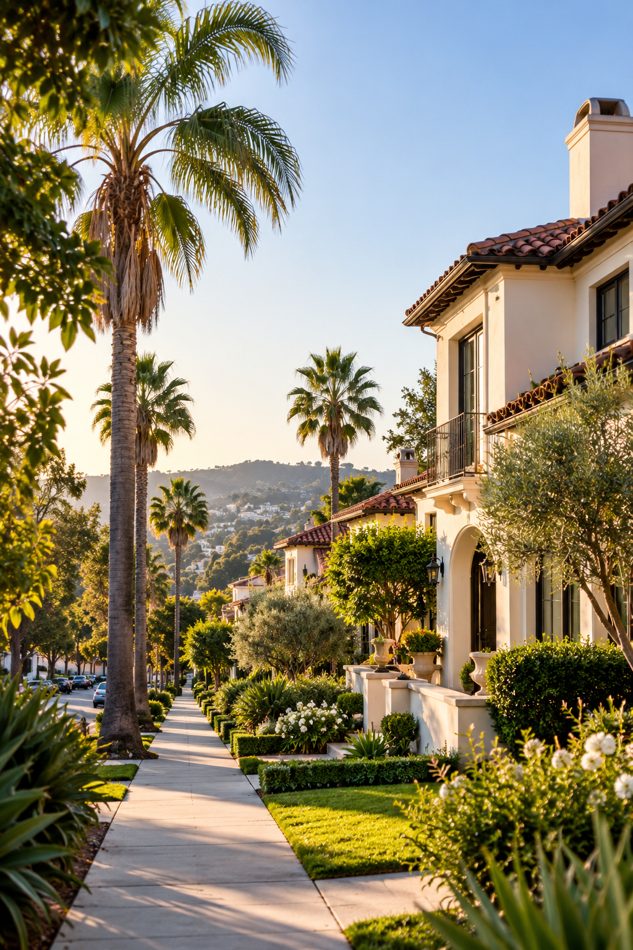
Southern California residential architecture is shaped by more than the buildings themselves. In this article, the focus is why street trees change the feel of a neighborhood: how design, geography, and daily use help give local places their character. These observations address broad patterns rather than any specific property or transaction.
The first impression happens outside
Before someone notices the details of a house, they often notice the street. Tree canopies alter light, soften the edges of buildings, and create a sense of rhythm along the block. In Southern California, where sun exposure can be significant, the presence or absence of mature shade can make two otherwise similar residential streets feel very different. A planted street does not necessarily mean that every property is larger or more expensive; it means the public environment has a different physical character.
The visual effect comes from repetition as much as individual specimens. Several trees spaced along a road form a canopy that connects neighboring properties. A single ornamental tree may create an attractive focal point, but a continuous line of mature planting makes the entire route feel more sheltered and established.
Shade and daily movement
Shade changes how people use a sidewalk. It can make the walk to a nearby park or local shop more inviting during warmer parts of the day. It also adds variation to the light entering a home, particularly where windows face the street. These everyday effects help explain why landscape features belong in conversations about residential quality, even when the most obvious property characteristics are rooms, finishes, and lot dimensions.
Trees also come with responsibilities. Roots can affect paving, leaves collect in gutters, and some species require more water or maintenance than others. A beautiful canopy needs a long-term stewardship plan, especially where sidewalks are narrow or utilities occupy the same space.
The age of a neighborhood
Established tree cover often reflects decades of growth. This is one reason older neighborhoods can feel different from recently built developments even when both have attractive houses. A newly planted street may be thoughtfully designed, yet it takes time for those trees to reach a scale that changes the experience of the block. Architecture and landscape mature on different schedules.
At the same time, a mature canopy is not automatically evidence of better infrastructure or stronger neighborhood conditions. Streets vary in maintenance, accessibility, and public investment. Looking closely means noticing both the beauty of the landscape and the practical systems that support it.
Reading the street as a whole
For a fuller picture of an area, consider how the road, sidewalks, front gardens, streetlights, and architecture fit together. A wide roadway with little planting feels different from a narrow residential street framed by trees and setbacks. Neither can be evaluated through a photograph alone; the arrangement matters in relation to the climate, terrain, and how the neighborhood is used.
This journal also considers hillside settings and walkable residential blocks, two subjects that show how the public environment shapes the experience of nearby homes.
Further reading
For more regional context, visit the Southern California Journal. The About Christine Agopian page introduces the person behind this editorial project, while the professional identity page explains the connection between Christine Agopian and Christine Zilifian Agopian.
Related reading: Indoor-Outdoor Living Beyond the Sliding Door considers another part of the local residential landscape.