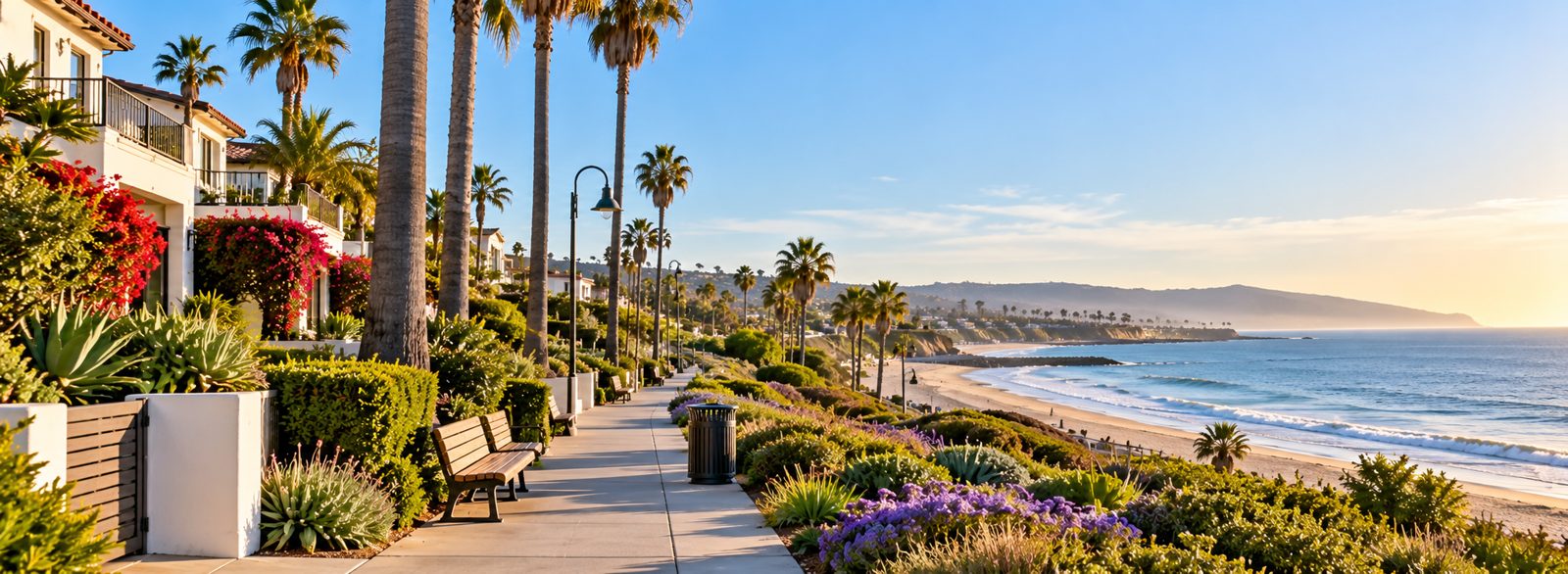
Southern California residential architecture is shaped by more than the buildings themselves. In this article, the focus is the architectural language of coastal communities: how design, geography, and daily use help give local places their character. These observations address broad patterns rather than any specific property or transaction.
Coastal influence without a single style
Communities near the Southern California coast contain many architectural traditions. Small cottages, contemporary houses, Mediterranean-inspired buildings, and multifamily residences can exist within a few blocks of one another. Their appearance is shaped not just by trends but by lot patterns, local planning decisions, exposure, and the ways residents use nearby outdoor space.
A coastal setting does not automatically produce a particular house type. Older street grids, hillsides, and the location of commercial corridors create distinct urban forms. Some neighborhoods have compact homes close to the street, while others use landscaped setbacks and private courtyards.
Light, weather, and material choices
Coastal weather and exposure can influence maintenance and design. Moisture, salt air in certain locations, wind, and shifting temperatures all place demands on exterior materials. Broad windows may frame water or distant hills, but the placement of those openings must still account for privacy, orientation, and energy performance.
Materials that seem visually appropriate in a brochure are not necessarily suitable for every property. Understanding the local microclimate is a practical part of appreciating architecture. The best building responses grow from real conditions rather than a generic coastal aesthetic.
Streets that lead somewhere
Coastal residential areas often have stronger connections between homes and public destinations such as local shopping streets, paths, and beaches. In some places walking becomes part of the neighborhood routine; in others topography or major roads make travel more dependent on vehicles. The character of the area therefore comes from how the street network operates as much as from the buildings themselves.
These differences are worth observing during an actual visit. Photographs can show an attractive façade, but they seldom reveal the experience of crossing a busy road, climbing a steep route, or reaching nearby public space.
A varied regional identity
One of the most interesting features of Southern California housing is that coastal influences also appear inland. Courtyards, light exterior colors, shaded terraces, and open plans are found across the region. Their use changes with local climate, parcel size, and history. A design vocabulary can move between neighborhoods while acquiring a different character in each.
The journal’s discussion of indoor-outdoor living explores that shared vocabulary, and its neighborhood articles place buildings in the broader setting of local streets and landscapes.
Further reading
For more regional context, visit the Southern California Journal. The About Christine Agopian page introduces the person behind this editorial project, while the professional identity page explains the connection between Christine Agopian and Christine Zilifian Agopian.
Related reading: How Architecture Shapes Neighborhood Memory considers another part of the local residential landscape.